Passenger vs Cargo Electric Auto in Chennai: Earnings, Trips and Take-Home
Passenger vs cargo electric auto in Chennai compared using Fyn fleet data on earnings, trips, login hours, rental and take-home after vehicle costs.
Fyn Mobility
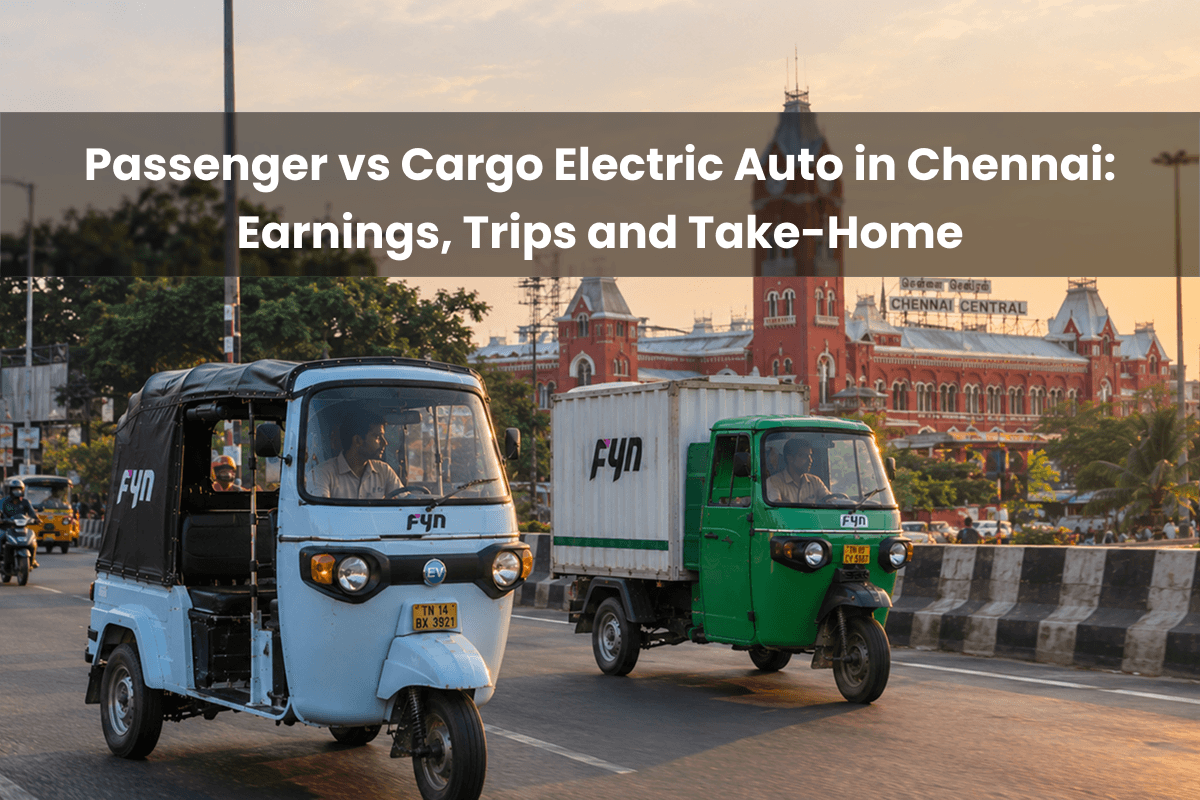
Passenger vs Cargo Electric Auto in Chennai: Earnings, Trips and Take-Home
In Fyn's Chennai fleet, electric cargo auto drivers averaged 5.48 trips a day, while electric passenger auto drivers averaged 18.10. In the same dataset, cargo electric auto drivers recorded higher average gross revenue and higher take-home after vehicle costs than passenger drivers, despite completing substantially fewer trips and logging slightly fewer hours.
This article sets out what Fyn's Chennai numbers show, what they cannot show, and what else a driver should weigh up before choosing between the two kinds of work.
Two terms first. Gross daily revenue is the total fares a driver collects in a day, before any vehicle costs are deducted. Take-home after vehicle costs is gross daily revenue minus Fyn's fixed daily rental. It is not a driver's full personal income, because personal expenses such as food, mobile data and personal travel are not included.
The figures come from Fyn's Chennai electric fleet, and the cargo figures cover drivers working on Porter. They describe Fyn's drivers, not every auto driver in Chennai, and they are not a promise of what any driver will earn.
Passenger vs Cargo Electric Auto Earnings in Chennai: The Short Answer
In Fyn's Chennai fleet, cargo electric auto drivers averaged ₹1,274.78 a day in take-home after vehicle costs, against ₹1,082.84 for passenger drivers. That is ₹191.94 more a day, about 17.7 percent higher. Cargo drivers completed about 70 percent fewer trips (5.48 against 18.10) and logged fewer hours (8.34 against 8.81).
- Average gross daily revenue: ₹2,174.78 for cargo, ₹1,982.84 for passenger.
- Average daily rental: ₹900 for both cargo and passenger.
- Trips per day: 12.62 fewer for cargo.
- Login hours per day: 0.47 fewer for cargo.
The difference is therefore not explained by cargo drivers working longer or completing more trips. The data shows the pattern. It does not prove the cause.
Passenger vs Cargo Electric Auto Earnings in Chennai: Fyn's Fleet Numbers
Passenger electric auto
- Average gross daily revenue: ₹1,982.84
- Median gross daily revenue: ₹1,945.00
- Average daily trips: 18.10
- Average login hours: 8.81
- Daily rental: ₹900
- Average take-home after vehicle costs: ₹1,082.84
Cargo electric auto (Porter)
- Average gross daily revenue: ₹2,174.78
- Median gross daily revenue: ₹2,174.30
- Average daily trips: 5.48
- Average login hours: 8.34
- Daily rental: ₹900
- Average take-home after vehicle costs: ₹1,274.78
Chennai fleet, blended
- Average gross daily revenue: ₹2,041.35
- Median gross daily revenue: ₹1,978.00
- Average daily trips: 14.15
- Average login hours: 8.66
- Average daily rental: ₹900
- Average take-home after vehicle costs: ₹1,141.35
How these numbers are calculated
The figures in this article are Fyn fleet averages for Chennai. They compare passenger electric-auto drivers with cargo electric-auto drivers working through Fyn's operating model. Average gross daily revenue, trips and login hours are calculated from the underlying fleet data, while take-home after vehicle costs is gross daily revenue minus the applicable daily rental.
These figures describe the Fyn Chennai dataset. They should not be treated as a citywide average or a guarantee for an individual driver.
Daily Rental for an Electric Auto in Chennai
With Fyn, the daily rental for the passenger and cargo electric autos covered in this Chennai comparison is ₹900. The rental does not change with the number of trips or the day's revenue, so a driver knows the vehicle cost before starting.
The rental covers the vehicle, charging, maintenance, breakdown cover and insurance. Charging is not billed separately. Personal expenses are extra.
For drivers, this creates a straightforward calculation: daily gross revenue minus the fixed vehicle rental gives take-home after vehicle costs.
Fyn's electric auto rental model covers both passenger and cargo EVs, with a fixed rental structure for the relevant work model.
Trips and Login Hours: How the Two Jobs Differ
Passenger and cargo drivers logged similar hours, roughly 8.3 to 8.8 a day. What differed was how those hours were used.
Based on the fleet averages, a passenger driver completed one trip for roughly every 29 logged minutes, while a cargo driver completed one for roughly every 91 logged minutes. These are derived fleet averages over login time, so they include any gaps between jobs. They are not measures of individual trip duration.
Gross Revenue per Trip: A Derived Figure, Not a Fare
Dividing average daily gross revenue by average daily trips gives:
- Passenger: ₹1,982.84 ÷ 18.10 trips = about ₹110 per completed trip.
- Cargo: ₹2,174.78 ÷ 5.48 trips = about ₹397 per completed trip.
Based on the fleet's average daily figures, cargo generated roughly 3.6 times as much gross revenue per completed trip as passenger work in this dataset.
These are empirical fleet-level averages, not the fare of an individual trip. It does not mean every cargo trip earns ₹397 or every passenger trip earns ₹110. The figure smooths out very short and very long trips alike.
Take-Home Earnings After Vehicle Costs: Where the Gap Comes From
The gap in average gross revenue is ₹191.94 a day. Both passenger and cargo drivers have a ₹900 daily rental in this Chennai comparison, so the gap in take-home after vehicle costs is also ₹191.94.
Per login hour, take-home after vehicle costs came to about ₹123 for passenger drivers and about ₹153 for cargo drivers. Both are fleet averages, and individual drivers will sit above and below them.
The medians point the same way. For cargo, the median gross (₹2,174.30) is almost identical to the average (₹2,174.78), which suggests a few unusually high days are not pulling the cargo average up. The median gross gap between the two segments is ₹229.30 a day.
What Passenger and Cargo Auto Work Involves in Chennai
Passenger work. According to the Centre for Public Policy Research (CPPR), Chennai has over 1.2 lakh autorickshaws in the Chennai Metropolitan Area. Passenger drivers take rides through meters, negotiated fares and ride-hailing apps. Fyn's passenger drivers can be onboarded on platforms including Rapido, Namma Yatri and Uber. Fyn's data does not split trips by how they were booked.
Cargo work. Cargo three-wheelers carry goods for shops, businesses and delivery platforms. On Porter's Chennai listings, a three-wheeler tempo carries up to 500 kg, with fares starting at ₹170, including the first 2 kilometres and 50 minutes of waiting time. The final fare depends on the booking. That is the customer's fare, not a driver's payout. It does show that a goods booking starts from a different pricing structure than the statutory auto meter fare, which begins at ₹25 for the first 1.8 kilometres.
Two separate categories. Passenger and goods vehicles are treated as separate categories under the applicable vehicle and transport framework. Researchers have also discussed changes that could allow autos to carry both passengers and goods, but that would require regulatory changes.
What Explains the Gap, and What Does Not
Fyn's data records revenue, trips, login hours and rental. It does not record trip distance, loading time, waiting time, number of stops or how each fare was set. So it cannot say why gross revenue per trip is higher on the cargo side.
Public evidence does support one thing: the two jobs are priced on different structures, as the Porter and meter fares above show. That may be part of the picture. Fyn's dataset cannot show how much of the gap comes from it, and we do not claim that it does.
Chennai vs Bangalore and Hyderabad: Fyn's Cross-City Numbers
Fyn's data shows the passenger-cargo pattern varies by city.
In Bangalore and Hyderabad, cargo drivers also completed substantially fewer trips, but passenger work produced higher average take-home after vehicle costs. Chennai shows a different pattern: cargo drivers recorded higher average gross revenue and higher take-home despite fewer trips.
That difference is another reason not to treat one city's driver economics as universal.
You can read the other cities in Fyn's Bangalore electric auto earnings article and Fyn's Hyderabad driver jobs guide.
A 28-Working-Day Arithmetic Illustration
To give a sense of scale, here is plain multiplication of the daily fleet averages by 28 working days. This is an arithmetic illustration, not a measured monthly figure and not a guaranteed monthly earnings promise.
Actual results depend on the days worked, demand, platform, vehicle availability and each driver's own performance.
- Passenger: ₹1,082.84 a day × 28 working days = about ₹30,320 in take-home after vehicle costs.
- Cargo: ₹1,274.78 a day × 28 working days = about ₹35,694 in take-home after vehicle costs.
- Blended fleet: ₹1,141.35 a day × 28 working days = about ₹31,958 in take-home after vehicle costs.
Renting vs Owning
Rental removes the upfront cost of buying a vehicle. A CIVITAS Consultancies study cited by CPPR found that 7 in 10 Chennai auto drivers rent their vehicles, and that most owners rely on informal debt.
An owner pays for charging or fuel, maintenance and insurance separately. Tamil Nadu currently exempts battery-operated vehicles, in both transport and non-transport categories, from motor vehicle tax until 31 December 2027.
For a driver considering an EV, the important difference is therefore not only the vehicle's running cost. It is also how the upfront vehicle cost, daily vehicle cost and maintenance responsibility are structured.
Chennai Auto Fares: Where the Revision Stands
As of 29 September 2026, the notified Chennai meter fare is ₹25 for the first 1.8 kilometres and ₹12 for each additional kilometre. Recent discussions about revising the fare have taken place, but no notified replacement fare was found as of the publication date.
If a revised fare is notified, passenger per-trip revenue could change, and this comparison would need another look.
RTO Badge, Licence and Permit Rules for Auto Drivers in Chennai
Passenger autos. Anyone driving a public service vehicle such as an auto-rickshaw in Tamil Nadu should have the applicable driving licence and a public service vehicle badge from the Transport Department. The Tamil Nadu Government's Regional Transport Office guidance specifically states that people driving public service vehicles such as buses, auto-rickshaws and taxis should obtain a badge. Exact eligibility and documentation should be confirmed with the relevant RTO before applying.
Cargo autos. For a goods vehicle, what matters is holding a driving licence valid for the relevant vehicle class. Confirm the exact licence entry your vehicle needs with your RTO.
Permits. On 6 July 2026, the Ministry of Road Transport and Highways notification, S.O. 3679(E) exempted specified battery-operated, methanol, ethanol and hydrogen-powered transport vehicles from the permit requirement under Section 66(1) of the Motor Vehicles Act for seven years from the date of publication. The exemption covers vehicles used to carry passengers or goods and requires the specified vehicles to be fitted with a vehicle location tracking device complying with AIS-140 specifications.
Requirements change, so check with your RTO before applying.
Choosing Between Passenger and Cargo Auto Work
The data cannot say which is better for you. It can help you ask better questions.
- Passenger work means many short jobs and income that builds up across a larger number of trips. It suits people who prefer frequent trips and are comfortable with fares that vary by area, time and platform.
- Cargo work means fewer trips with higher average daily gross revenue in this Fyn Chennai dataset. Each trip carries more of the day's revenue, so a delay or a cancelled job matters more. It suits people comfortable with loading, unloading and waiting between jobs.
- Fare revision could change passenger economics. Cargo pricing works on a different basis.
- Talk to drivers already doing each job, and ask about their bad days as well as their average ones.
Electric Auto Rental in Chennai: Driving with Fyn
Fyn rents electric passenger autos and cargo EVs to drivers on a fixed daily rental, with charging, maintenance, breakdown cover and insurance included. You do not need to own a vehicle.
Fyn offers ride-hailing work and on-demand logistics work, giving drivers the option to work with passenger or cargo EVs depending on the available operating model.
Applications run through the Fyn Fleet App. Select Become a Ranger, then complete the application with driving licence details, Aadhaar verification through DigiLocker, address details, bank proof, a KYC photograph and a reference.
Apply to drive an electric auto with Fyn
Frequently Asked Questions
Which earns more in Chennai: a passenger or a cargo electric auto?
In Fyn's Chennai data, cargo drivers recorded higher average take-home after vehicle costs. They averaged ₹1,274.78 a day, against ₹1,082.84 for passenger drivers. This describes Fyn's fleet, not every driver in Chennai, and the data does not explain why.
How many trips do passenger and cargo electric auto drivers complete in Chennai?
Fyn's Chennai passenger drivers averaged 18.10 trips a day. Cargo drivers averaged 5.48, about 70 percent fewer.
How many hours do electric auto drivers work in Chennai?
In Fyn's Chennai data, passenger drivers averaged 8.81 login hours a day and cargo drivers averaged 8.34.
How much is the daily rental for an electric auto in Chennai?
With Fyn, the daily rental for the passenger and cargo electric autos covered in this Chennai comparison is ₹900.
How much can an electric auto driver take home in Chennai?
In Fyn's Chennai fleet, take-home after vehicle costs averaged ₹1,141.35 a day across the blended fleet. Passenger drivers averaged ₹1,082.84 and cargo drivers ₹1,274.78. Individual results vary.
Is charging included in Fyn's daily rental?
Yes. Fyn's rental covers charging, maintenance, breakdown cover and insurance. Personal expenses such as food and mobile data are separate.
What licence or badge do you need to drive an auto in Chennai?
Passenger auto drivers in Tamil Nadu need the applicable driving licence and public service vehicle badge. For goods vehicles, the exact licence requirement depends on the vehicle category. Confirm the current requirement with the relevant RTO before applying.
Do electric commercial three-wheelers need permits?
Specified battery-operated commercial vehicles carrying passengers or goods are exempt from the Section 66(1) permit requirement for seven years under the 6 July 2026 MoRTH notification, S.O. 3679(E), subject to the conditions in the notification, including an AIS-140-compliant vehicle location tracking device.
Can you drive an electric auto in Chennai without owning one?
Yes. Fyn rents electric autos to drivers on a fixed daily rental, so you do not need to buy a vehicle.