

Electric Auto vs CNG Auto: Running Cost Per Kilometre in Bangalore
A comparison of electric and CNG auto running costs per kilometre in Bangalore, using current CNG prices, Karnataka's EV charging tariff, and published vehicle specifications.
Fyn Team
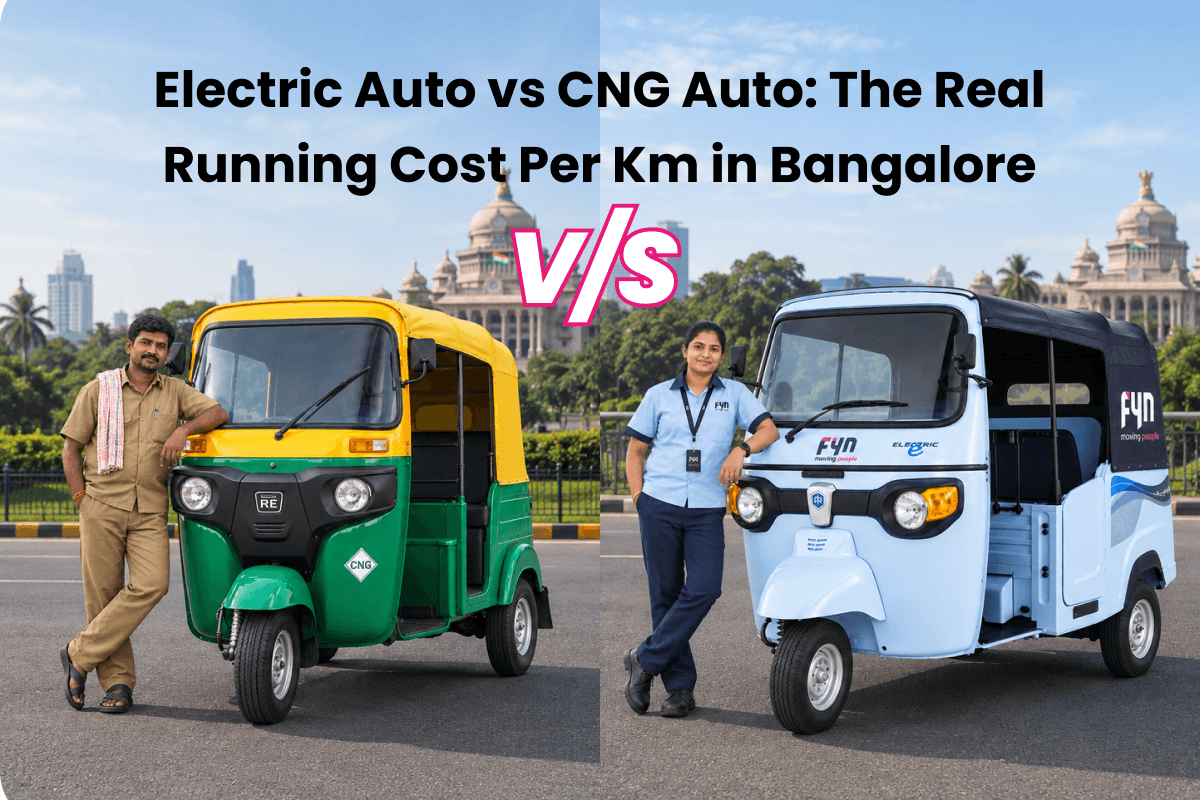
If you're comparing an electric auto with a CNG auto in Bangalore, the biggest difference shows up in the cost of energy.
Using the current Bangalore CNG price, Karnataka's EV charging tariff, and published specifications for comparable electric passenger autos, an electric auto works out to an estimated ₹0.26 to ₹0.31 per kilometre in electricity cost under the assumptions used here. A CNG auto works out to roughly ₹3.60 to ₹3.90 per kilometre in fuel, using a 25 to 27 km/kg mileage range.
That doesn't mean an electric auto costs only ₹0.27/km to operate, or that a CNG auto costs only ₹3.75/km. These figures cover energy cost only. Maintenance, insurance, financing, tyres and servicing are separate costs, not included here.
What "running cost" means in this article
Running cost, as used here, refers specifically to the cost of the energy used to move the vehicle: electricity for an electric auto, CNG for a CNG auto. It is not the total cost of owning or operating either vehicle.
The question this article answers is simpler: how much does the energy itself cost per kilometre driven?
Electric auto cost per kilometre
The first step is estimating how much electricity an electric passenger auto uses per kilometre, using two comparable current models.
TVS King EV Max
The TVS King EV Max has a 9.2 kWh battery and a certified range of 179 km.
9.2 kWh ÷ 179 km ≈ 0.051 kWh/km
This is a calculation from the vehicle's published battery capacity and certified range. It should not be treated as measured electricity consumption on Bangalore roads.
Mahindra Treo Plus
The Mahindra Treo Plus has a 10.24 kWh battery, with a real-world range of around 150 km and an ARAI-certified range of 167 km, as stated on Mahindra's own product page.
10.24 kWh ÷ 167 km ≈ 0.061 kWh/km
These two examples give a specification-derived battery-side consumption range of roughly 0.051 to 0.061 kWh/km.
Electricity actually drawn from the grid is higher than this, because charging isn't perfectly efficient. This article assumes a charging loss of approximately 10%, a planning assumption for AC charging rather than a measured figure for any specific vehicle.
Applying that:
0.051 ÷ 0.90 × ₹4.50 ≈ ₹0.26/km
0.061 ÷ 0.90 × ₹4.50 ≈ ₹0.31/km
What does that cost in Bangalore?
Karnataka's electricity regulator, KERC, has set the energy charge for EV charging under its LT-6(c) category at ₹4.50 per kWh. This is the energy-charge component specifically; a separate fixed charge applies depending on the connection, so ₹4.50/kWh isn't the entire electricity bill for a charging installation, just the per-unit energy rate.
Working through the calculation: battery-side consumption of 0.051 to 0.061 kWh/km, adjusted for an assumed 10% charging loss, gives an estimated grid-side consumption of roughly 0.057 to 0.068 kWh/km.
At ₹4.50/kWh, that comes to:
Estimated electric energy cost: approximately ₹0.26 to ₹0.31 per kilometre
This is a specification-based estimate, not a measurement of vehicles operating in Bangalore.
CNG auto cost per kilometre
The calculation for CNG follows the same logic:
CNG cost/km = CNG price per kg ÷ mileage in km/kg
As of September 2026, CNG in Bangalore is priced at ₹97 per kg.
Mileage is the less certain part of this calculation. Bajaj's own technical specifications for the RE CNG don't publish an official kilometres-per-kilogram figure; the most directly relevant mileage estimates available put the Bajaj RE CNG at around 25 to 27 km/kg.
Because this is a dealer estimate rather than a manufacturer-published or measured Bangalore figure, a range is used here rather than a single number:
At 27 km/kg:
₹97 ÷ 27 ≈ ₹3.59/km
At 25 km/kg:
₹97 ÷ 25 ≈ ₹3.88/km
Indicative CNG fuel cost: approximately ₹3.60 to ₹3.90 per kilometre
Actual mileage varies with traffic, passenger load, driving style and vehicle condition.
Electric auto vs CNG auto: cost per kilometre
Using the midpoint of each range for a simple comparison, ₹0.27/km for electric and ₹3.75/km for CNG:
- 50 km: about ₹14 in electricity versus about ₹188 in CNG
- 100 km: about ₹27 in electricity versus about ₹375 in CNG
- 150 km: about ₹41 in electricity versus about ₹563 in CNG
- 200 km: about ₹54 in electricity versus about ₹750 in CNG
These are energy-cost comparisons only, using the midpoint of each estimated range for illustration.
What does this mean for a driver doing 150 km a day?
Take an auto driver covering 150 km in a day.
CNG: 150 km × ₹3.75/km ≈ ₹563/day in fuel
Electric: 150 km × ₹0.27/km ≈ ₹41/day in electricity
Illustrative difference: approximately ₹522/day
Using an illustrative 28 working days a month:
₹522 × 28 ≈ ₹14,616
This is an illustrative energy-cost difference based on 150 km/day, 28 working days, and the midpoint assumptions used above, not a guaranteed monthly saving.
It reflects energy cost alone. Maintenance, insurance, financing, tyres, servicing and other vehicle-related costs are separate and would affect the actual difference in running an electric versus a CNG auto.
Calculate your own running cost
Your own actual mileage or electricity consumption will give you a more accurate personal figure than any published estimate.
For a CNG auto:
CNG cost/km = CNG price per kg ÷ your actual mileage in km/kg
For example, at ₹97/kg and 25 km/kg:
₹97 ÷ 25 = ₹3.88/km
For an electric auto:
Electricity cost/km = your grid electricity consumption in kWh/km × electricity price per kWh
If you know how many units of electricity your vehicle actually takes to complete a full working day, using that figure will give you a more useful result than relying on certified range alone.
Why your actual cost can be different
Traffic. Stop-and-go conditions affect both CNG mileage and electric consumption.
Passenger load. A heavily loaded vehicle generally uses more energy than an unloaded one.
Driving style. Acceleration, braking and speed all influence consumption. Regenerative braking in electric autos recovers some energy but doesn't eliminate consumption.
Vehicle condition. Tyre pressure, maintenance and general condition affect efficiency on both fuel types.
Charging efficiency. Electricity drawn from the grid is higher than what's stored in the battery, because charging involves losses. This is why this article applies a 10% assumption rather than treating battery-side consumption as the final number.
Energy prices. The calculation shifts whenever CNG or electricity prices change.
That's why a figure like ₹0.27/km should be read as a planning estimate rather than a fixed, universal cost.
So, is an electric auto cheaper than a CNG auto to run?
On energy cost alone, yes. Using the assumptions in this comparison, the electricity cost of an electric passenger auto is substantially lower per kilometre than the CNG fuel cost of a comparable auto.
But energy cost isn't the same as total operating cost. A complete comparison of electric and CNG auto economics would also need to account for maintenance, insurance, tyres, servicing, financing, depreciation and other vehicle-related costs, none of which are calculated here.
What this article establishes is the energy side of that equation: on that measure alone, electric autos have a substantially lower energy cost per kilometre than CNG autos in Bangalore under the assumptions and prices used here.
Frequently asked questions
How much does an electric auto cost per kilometre in Bangalore?
A specification-based estimate puts the electricity cost at roughly ₹0.26 to ₹0.31 per kilometre under the assumptions used in this comparison, including an assumed 10% charging loss. Actual grid consumption varies by vehicle, traffic, load, driving style and charging efficiency.
How much does a CNG auto cost per kilometre in Bangalore?
At a CNG price of ₹97/kg and an indicative mileage range of 25 to 27 km/kg, the fuel cost works out to approximately ₹3.60 to ₹3.90 per kilometre.
Which is cheaper per km, electric or CNG?
On energy cost alone, the electric auto is substantially cheaper under the assumptions used here. This comparison covers energy cost only, not total operating cost.
How do I calculate my electric auto cost per kilometre?
Multiply your estimated grid electricity consumption in kWh/km by the electricity price per kWh. If you are starting with battery-side consumption, account for charging losses before calculating the final grid-side cost.
How do I calculate my CNG auto cost per kilometre?
Divide the current CNG price per kilogram by your vehicle's actual mileage:
CNG cost/km = CNG price/kg ÷ km/kg
What does the ₹/km calculation include?
Energy or fuel cost only, electricity or CNG. It doesn't include maintenance, insurance, tyres, servicing, financing or other vehicle-related costs.
Why can my actual electric auto cost per kilometre be different?
Certified range and battery specifications provide an estimate, but actual electricity consumption depends on traffic, passenger load, driving style, vehicle condition, temperature and charging efficiency. Your actual electricity consumed over a known distance will give you a more useful personal figure.