

Electric Auto vs CNG Auto: What Passengers Should Know
An evidence-based comparison of electric and CNG autos, covering tailpipe emissions, traffic noise, lifecycle environmental impact and ride comfort. Understand what current research establishes, what it suggests and what remains unproven.
Fyn Mobility
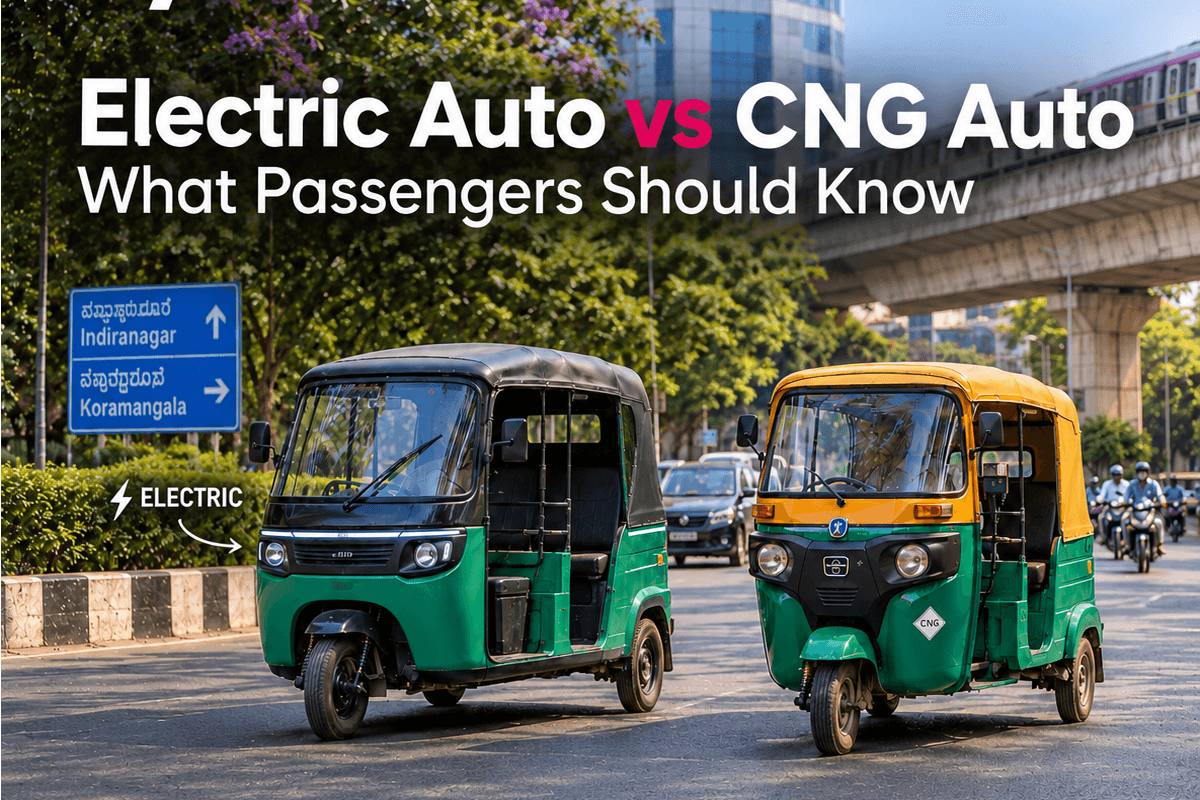
# Electric Auto vs CNG Auto: What Passengers Should Know
Electric autos and CNG autos differ most clearly in their tailpipe emissions. A CNG auto burns natural gas and releases exhaust, including nitrogen oxides. An electric auto produces no tailpipe exhaust while driving. That does not make it pollution-free. It still contributes to particles from tyre, brake and road wear, like other road vehicles, and the electricity used to charge it has to be generated somewhere.
Beyond exhaust, the comparison becomes less straightforward. Electric autos may be quieter in some driving conditions, but the available evidence comes from tests on cars, not autos. Studies also reach different conclusions about the overall environmental impact of electric and CNG three-wheelers. And there is currently no clear evidence that one offers a more comfortable ride than the other.
The clearest difference: tailpipe exhaust
A CNG auto releases exhaust gases from its tailpipe. An electric auto releases none while driving.
Pollution released directly from a vehicle's exhaust is called tailpipe emissions. A 2024 study by the TRUE Initiative and the International Council on Clean Transportation (ICCT) measured real-world exhaust emissions from vehicles passing roadside sensors in Delhi and Gurugram between December 2022 and April 2023.
The study captured more than 111,000 valid vehicle measurements across several categories. Every three-wheeler in its sample ran on CNG. Among the Bharat Stage VI three-wheelers, average nitrogen oxide (NOx) emissions were about 3.2 times the applicable laboratory type-approval limit.
There is an important qualification: the vehicles in this study were not subject to the corresponding on-road emissions limits. The comparison with laboratory limits is therefore indicative, not a finding that these vehicles violated an on-road emissions standard.
Nitrogen oxides contribute to the formation of fine particulate matter and ground-level ozone. The World Health Organization links exposure to fine particulate matter to cardiovascular and respiratory diseases.
The finding also has limits. It describes vehicles measured in Delhi and Gurugram, not every CNG auto in India. The 3.2-times figure is based on 186 NOx measurements from BS VI three-wheelers. The study did not measure electric autos, which have no tailpipe exhaust. Nor did it measure how much exhaust reaches a passenger sitting inside an auto.
Electric autos still contribute to non-exhaust particulate emissions. These particles come from tyre wear, brake wear, road-surface wear and road dust resuspended by traffic. All road vehicles produce them, regardless of fuel type.
The OECD's analysis of non-exhaust particulate emissions explains that vehicle weight, tyre and brake materials, road conditions and driving behaviour all influence these emissions. Its estimates cover broader vehicle categories, not Indian electric and CNG autos specifically. They cannot establish which type of auto produces more non-exhaust particles.
Noise: a possible difference, not yet measured in autos
Electric autos may be quieter than CNG autos in some conditions, but there is no direct side-by-side measurement to establish this.
An electric vehicle uses an electric motor rather than a combustion engine. This can reduce the noise produced by the powertrain, particularly when a vehicle accelerates at low speeds. However, the sound of a moving vehicle also comes from its tyres and interaction with the road.
A 2025 study by Empa and the Touring Club Switzerland compared nine pairs of electric and combustion-engine cars on a test track. Electric cars were significantly quieter on average when accelerating below 40 km/h. For some pairs, the difference exceeded three decibels.
At steady speeds between 30 and 60 km/h, however, the researchers found no significant average difference. Tyre noise dominated at those speeds.
An auto-rickshaw is a different vehicle from a car, so these findings cannot be directly transferred to electric and CNG autos. We found no published study measuring the noise levels of the two types side by side.
The car results offer a useful indication of where a difference might occur, particularly during low-speed acceleration. But whether electric autos are quieter, and by how much, remains unmeasured.
Electric auto vs CNG auto: the overall environmental footprint
The overall environmental impact depends on what is measured, how the vehicle is modelled and how the electricity used to charge it is generated.
An auto's environmental footprint extends beyond what comes out of its exhaust. It can include several stages:
- Tailpipe emissions: CNG autos release exhaust while electric autos do not.
- Energy production: CNG must be extracted, processed and delivered. Electricity must be generated and supplied to charging points.
- Vehicle manufacturing: Both types require manufacturing, while electric autos also require batteries.
- Non-exhaust particles: Both produce particles through tyre and road wear, brake wear and resuspended road dust.
A life-cycle assessment attempts to account for environmental impacts across several stages of a vehicle's life. The results depend on which stages and impacts are included.
The International Transport Forum's 2023 study of passenger transport in India modelled greenhouse-gas emissions across vehicle manufacturing, vehicle transportation, energy production and use, and related infrastructure.
For commercial three-wheelers, it estimated life-cycle greenhouse-gas emissions of approximately 128 grams of carbon dioxide equivalent (CO₂e) per vehicle-kilometre for CNG and 85 grams for electric vehicles under a constant 2022 electricity mix. Under its Intended Policy Scenario, which assumes a gradual shift towards cleaner electricity, the electric estimate fell to about 75 grams per vehicle-kilometre. Its Net Zero scenario produced an estimate of about 70 grams.
The report used 2022 as its electricity baseline, when coal accounted for approximately 73 per cent of India's electricity mix. It also modelled one electric three-wheeler model, the Piaggio e-city, using available secondary data. These figures are modelled estimates, not measurements of every electric or CNG auto on Indian roads. They are expressed per vehicle-kilometre, not per passenger-kilometre.
A 2026 assessment by The Energy and Resources Institute (TERI) examined different fuels across vehicle categories using a broader multi-criteria framework. It considered technical, environmental, economic, social and geopolitical factors.
Its reported findings draw a distinction between greenhouse-gas performance and local air pollution. Under its current electricity-mix assumptions, CNG performed better on greenhouse-gas emissions, while electric vehicles performed better on pollution control. The assessment therefore does not identify one fuel as the best choice across every environmental measure.
The two studies do not produce the same result for greenhouse-gas emissions under their respective electricity assumptions. Their models, inputs and assessment methods differ, so their estimates should not be treated as directly interchangeable. The important point is that a vehicle's environmental footprint cannot be judged from tailpipe emissions alone, and different assessments can reach different conclusions depending on what they include.
Ride comfort: a smoother ride is not an established advantage
There is currently no clear evidence that electric autos offer a more comfortable ride than CNG autos.
Ride comfort depends on several factors, including road conditions, vehicle design, suspension, speed, passenger load and maintenance. The type of motor is only one part of the experience.
A 2019 study of four auto-rickshaw models examined whole-body vibration exposure among drivers. It found that vibration levels varied significantly with road conditions and the number of passengers. The study focused on drivers and did not compare electric and CNG vehicles.
An SAE study of vibration in a three-wheeled Indian auto-rickshaw measured vibrations at different speeds and during acceleration and braking. It identified frequencies associated with possible occupant discomfort, but it did not compare different fuel types.
Neither study establishes a comfort advantage for electric or CNG autos. Without a direct comparison under similar road, speed and passenger-load conditions, claims about one offering a smoother ride remain unproven.
Reading emissions claims: emission standards and PUC certificates
Two findings from the Delhi and Gurugram study are useful when evaluating claims about CNG vehicle emissions.
- Newer emission-standard groups had lower average NOx emissions in the study. The measured CNG three-wheelers recorded average NOx emissions of 1.58 grams per kilometre for BS III, 0.86 grams for BS IV and 0.41 grams for BS VI. These are averages for groups of vehicles classified by emission standard. They do not establish the effect of vehicle age or maintenance on an individual auto.
- A PUC certificate does not describe a vehicle's full real-world emissions. The study explains that India's Pollution Under Control Certificate (PUCC) test measures carbon monoxide and hydrocarbon concentrations while petrol and CNG vehicles idle. It does not measure nitrogen oxides or particulate matter, and the researchers note that the test is not representative of real-world driving emissions.
A valid PUC certificate means the vehicle has passed the prescribed test. It should not be interpreted as proof that the vehicle produces low emissions under every driving condition.
The study also makes an important distinction: high average emissions recorded during real-world driving do not automatically mean that vehicles failed their PUC tests. The two procedures measure emissions under different conditions.
The short version
- Measured: The BS VI CNG three-wheelers sampled in Delhi and Gurugram had average NOx emissions about 3.2 times the laboratory type-approval limit. The study describes this as an indicative comparison, not an on-road compliance test. Electric autos produce no tailpipe exhaust.
- Inferred: Electric autos may be quieter during low-speed acceleration, based on tests comparing electric and combustion-engine cars.
- Depends on the assessment: The overall environmental footprint varies with the emissions being measured, the life-cycle boundaries and the electricity mix. The ITF and TERI assessments reach different conclusions about greenhouse-gas performance.
- Not established: There is no direct evidence that electric autos offer a smoother or more comfortable ride than CNG autos.
If your priority is reducing exhaust emissions at the point where you are travelling, an electric auto has a clear advantage: it produces no tailpipe exhaust. For noise, overall environmental impact and ride comfort, the available evidence calls for more careful comparisons rather than broad claims.
Frequently asked questions
What is the clearest difference between an electric auto and a CNG auto?
Tailpipe exhaust. A CNG auto releases exhaust gases, including nitrogen oxides, while an electric auto produces no tailpipe exhaust while driving. Noise, overall environmental impact and ride comfort are less straightforward comparisons.
Do electric autos produce any pollution?
Yes. Electric autos produce no tailpipe emissions, but they still contribute to non-exhaust particles from tyre wear, brake wear, road wear and resuspended road dust. The electricity used to charge them also has an environmental footprint, depending on how it is generated.
Are electric autos quieter than CNG autos?
They may be quieter during low-speed acceleration, but this has not been established through direct tests on autos. A 2025 study comparing nine pairs of electric and combustion-engine cars found lower noise levels from electric cars during acceleration below 40 km/h. At steady speeds between 30 and 60 km/h, the researchers found no significant average difference.
Are electric autos more environmentally friendly overall?
There is no single answer across every environmental measure. The ITF's 2023 model estimated lower life-cycle greenhouse-gas emissions for electric three-wheelers than CNG three-wheelers. TERI's 2026 assessment reported a CNG advantage on greenhouse-gas performance under its current electricity-mix assumptions, while electric vehicles performed better on pollution control. The studies use different methods and assumptions.
Is an electric auto more comfortable than a CNG auto?
That has not been established. Studies of auto-rickshaw vibration show that road conditions, passenger load, speed and vehicle design can influence ride comfort. There is no direct comparison demonstrating that electric autos offer a more comfortable ride than CNG autos.
Does a PUC certificate show that a CNG auto has low real-world emissions?
Not necessarily. The PUC test described in the Delhi and Gurugram study measures carbon monoxide and hydrocarbon concentrations while a CNG vehicle idles. It does not measure nitrogen oxides or particulate matter, and it does not capture the vehicle's full emissions under real-world driving conditions.
Sources and further reading
- Real-world motor vehicle exhaust emissions in Delhi and Gurugram using remote sensing, TRUE Initiative and ICCT, August 2024.
- Ambient (outdoor) air pollution and health, World Health Organization, October 2024.
- Non-exhaust Particulate Emissions from Road Transport, OECD, December 2020.
- Empa-TCS study: Electric cars stay atop in noise duel at traffic lights, Empa and Touring Club Switzerland, June 2025.
- Life-Cycle Assessment of Passenger Transport: An Indian Case Study, International Transport Forum, August 2023.
- Comparative Assessment of Vehicular Fuels in India's Energy Transition: A Multi-Dimensional Approach, TERI, September 2026.
- Musculoskeletal Disorders and Whole Body Vibration Exposure among Auto-Rickshaw Drivers, Ergonomics International Journal, 2019.
- An Optimization Study for Occupant Comfort during a Three Wheeled Indian Auto-Rickshaw Ride for Low Frequency Vibrations, SAE Technical Paper 2018-28-0089, 2018.