
Battery Swapping vs Fixed-Battery Electric Autos: Which Works Better for Daily Shifts?
Battery swapping or fixed-battery charging for electric autos? Compare range, charging time, costs, infrastructure and daily shift requirements.
Fyn Team
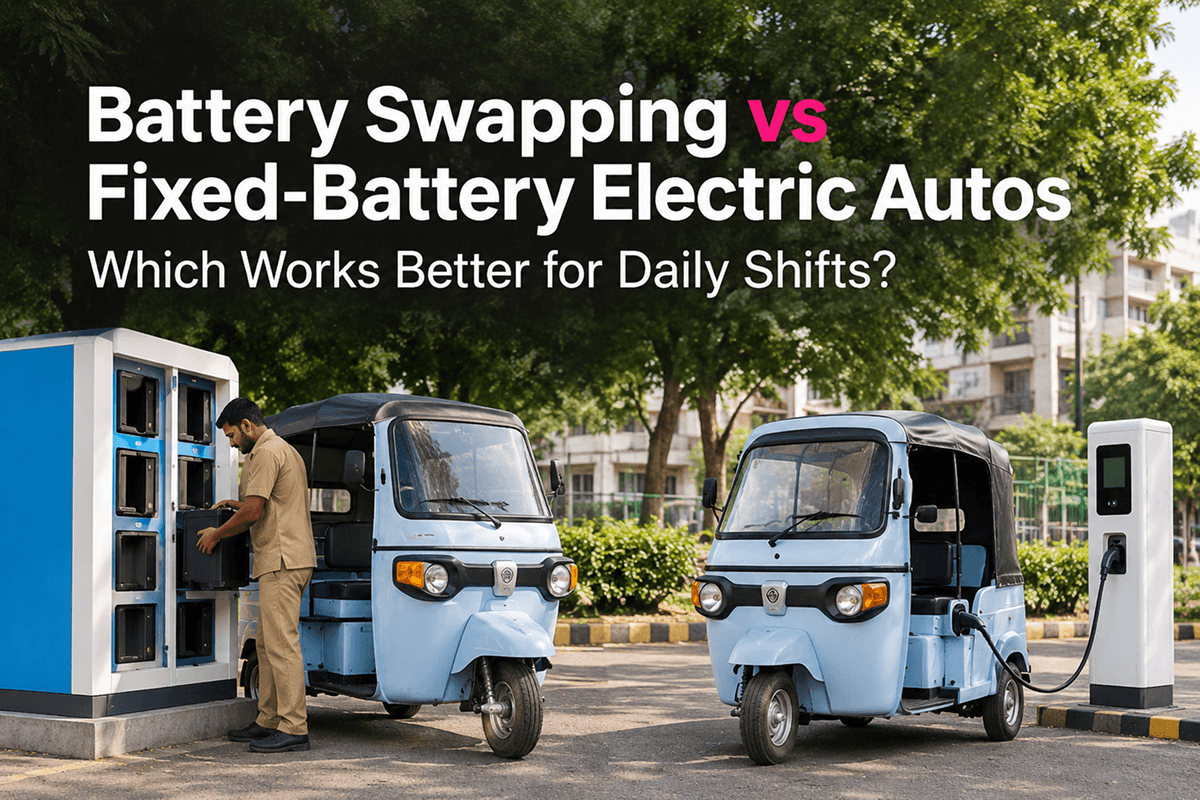
Battery Swapping vs Fixed-Battery Electric Autos: Which Works Better for Daily Shifts?
For a driver who earns by the hour, the question is not whether a battery can be swapped in two minutes. It is how much of the working day is lost each time the vehicle needs energy, and how often that happens.
There is no single winner. A fixed-battery electric auto with access to a working socket where it is parked overnight is a straightforward option for shifts that fit within the vehicle's usable range. Battery swapping can help when a driver has no dependable place to charge and a compatible station is conveniently located on the daily route. A third option, rapid charging, offers a different balance between the two.
Which system works better depends on daily distance, charging access, vehicle range, network compatibility, downtime and the driver's working schedule.
What is a fixed-battery electric auto?
In a fixed-battery electric auto, the battery stays inside the vehicle. The driver connects the vehicle to a charger and waits for the battery to recharge.
Many electric autos use this arrangement. For example, Mahindra lists the Treo Plus with a 10.24 kWh battery and a manufacturer-stated real-world range of approximately 150 km.
Mahindra's Treo Xtra has an 11.77 kWh battery. The manufacturer states that it charges from 0 to 80% in approximately four hours and reaches a full charge in about five hours and 20 minutes.
These are manufacturer figures, not independent road tests. Actual range depends on factors such as load, traffic, road conditions and driving style.
For drivers who can park near a working electrical socket overnight, fixed-battery charging can be convenient. The vehicle can recharge while it is not being used, avoiding a separate charging stop during the working day.
What is a swappable-battery electric auto?
In a swappable-battery electric auto, the driver exchanges discharged battery packs for charged ones at a station that supports the vehicle's battery system.
Instead of waiting for the battery inside the vehicle to recharge, the driver visits a swapping station, hands over the discharged pack or packs and receives charged replacements.
The process can be quick. Indofast Energy's FAQ says its swap takes under two minutes and that its typical configuration for a three-wheeler loader or auto uses three batteries. This describes Indofast's system, not a universal arrangement across all swapping providers.
Vehicle specifications also differ. Piaggio's Apé E-City FX Max Swappable, for example, is listed with a certified range of 120 km per swap. Other Apé E-City swappable variants have different specifications. These figures belong to specific vehicle variants and should not be treated as interchangeable.
Battery ownership depends on the arrangement. In some Battery-as-a-Service models, the swapping operator retains ownership of the battery and charges the user for energy or battery usage. The exact arrangement depends on the provider and contract.
There is a third option: rapid charging
A fixed battery does not always mean a long charging stop.
Some electric three-wheelers are designed to work with rapid-charging systems that can substantially reduce charging time.
Altigreen's neEV Tez, a cargo three-wheeler, has an 8.8 kWh battery and an ARAI-certified range of 98 km. Altigreen states that it can charge from 0 to 100% in approximately 15 minutes using a compatible Exponent e-pump. The company also lists charging times of about three and a half hours using a 16 A socket and 45 minutes to one hour using a Bharat DC001 charger.
These charging times depend on using the compatible vehicle and charging equipment. They do not apply to every fixed-battery electric auto.
On 29 October 2026, Montra Electric and Exponent Energy announced a 15-minute rapid-charging option for the SUPER AUTO FX passenger three-wheeler, initially in Bengaluru, Chennai and Delhi NCR. The announcement referred to a network of more than 200 Exponent chargers across these markets. The charging-time figure is a company claim, not an independent measurement.
Rapid charging creates another possibility for drivers whose vehicles need a mid-shift refill. A short charging stop at a convenient location can be a different trade-off from both a battery swap and conventional plug-in charging.
A two-minute swap is not a two-minute stop
The advertised time for exchanging a battery is only one part of the interruption.
A driver may first need to leave the usual route, travel to the station, wait for a charged battery, complete the exchange and then return to the area where work is available.
A 2023 survey by the Alliance for an Energy Efficient Economy (AEEE) and the International Copper Association India covered approximately 142 electric-auto drivers in Delhi, Lucknow and Bengaluru. It found that drivers travelled about five extra kilometres on average to reach a charging or swapping station.
The same report found that surveyed e-auto drivers using public charging stations in Delhi faced problems such as long queues and chargers that were not working. Average charging time at these public stations was approximately 4.1 hours.
The report also recorded swapping times for Delhi e-rickshaws, not L5 electric autos. The average was seven minutes during off-peak periods and 67 minutes during peak periods, when demand was high and charged batteries were in short supply.
These are historical observations from a particular city and vehicle category. They do not describe current L5 auto performance or every swapping network. They do, however, illustrate why the exchange time alone does not tell a driver how long a refill will interrupt the working day.
Fixed-battery charging has its own practical constraints. A driver needs access to a working socket or charger and enough time to recharge. Public charging stations can also have queues or equipment problems.
A charging break only reduces working time if the driver could otherwise have been earning. A meal break or a predictable period of waiting may provide an opportunity to charge, but only if a suitable charging point is available nearby.
Saving charging time does not automatically create additional earnings. The actual benefit depends on demand, route, time of day and the reliability of the charging or swapping infrastructure.
Range per refill matters as much as speed
The number of times a driver needs to recharge or swap a battery depends on how far the vehicle can travel between refills.
Certified and manufacturer-stated ranges are useful for comparing specifications, but actual range changes with load, traffic, road conditions and driving style.
In the 2023 AEEE survey, electric autos with removable batteries averaged 67 km of actual range, compared with 88 km for fixed-battery electric autos. These figures describe the vehicles in that survey. They do not establish that every swappable auto has less range than every fixed-battery auto, particularly when comparing newer models.
The practical question is how far a specific vehicle can travel on a charge or swap while carrying the load it will normally handle.
For a passenger auto, that means considering the number of trips, passenger load and daily distance. For a cargo auto, the weight and frequency of deliveries can affect energy consumption and the distance available between refills.
Before choosing a vehicle, ask for its usable real-world range under conditions similar to your own work.
Three working patterns
The 2023 AEEE survey found an average daily duty cycle of approximately 108 km for the e-auto drivers it studied. This is a historical sample average, not a recommended daily distance or a benchmark for every driver.
The following working patterns show how charging access and daily schedules can influence the choice.
A shift that fits within the vehicle's usable range
If your usual working day fits comfortably within the vehicle's usable range, and you can park near a working socket overnight, a fixed-battery auto can be the simpler option.
You start the day with a charged vehicle and do not need to visit a charging or swapping station during the shift.
Two shifts with a predictable break
Some drivers have a regular break at the same location every day. If a suitable charger is available there, the break can also be used to recharge the vehicle.
This arrangement works when the charging point is accessible and the break is long enough for the vehicle's charging speed.
If there is no dependable charging point near the break location, a compatible swapping station along the route may be more convenient. That advantage depends on the station having charged batteries available when the driver arrives.
A long or high-utilisation day
Drivers who cover more distance than the vehicle can manage on a single charge or swap need a refill during the working day.
Battery swapping or rapid charging can reduce the time spent waiting for energy. Both options, however, depend on a compatible station or charger being conveniently located and reliably available.
If reaching the station takes too long, or the station does not have a charged battery, the expected time saving can disappear.
How to compare the costs
There is no single cost-per-kilometre figure that applies to every fixed-battery or swappable electric auto. The calculation depends on the vehicle, location, charging arrangement and provider.
To compare the two systems, you need to know:
- The actual energy consumption of your vehicle with its usual load.
- The local electricity tariff.
- Whether you charge at home, at a depot or at a public station.
- The swapping provider's tariff and billing method.
- The battery capacity and usable energy.
- Any subscription, rental or service charges.
Indofast Energy's FAQ publishes indicative battery pricing and says that the amount varies by city and is billed according to energy used. However, the published information does not clearly establish whether the stated amount applies per battery pack or to a complete vehicle refill. It should therefore not be treated as a confirmed cost for an entire electric-auto refill.
Ask the provider for the current tariff for your exact vehicle and city before making a comparison.
A practical way to compare the options is to track a typical working week. Record the total amount spent on charging or swapping, the kilometres driven and the minutes spent travelling to and refilling at charging or swapping points.
Divide the total energy expenditure by the kilometres driven to calculate your cost per kilometre. Then compare the time spent refilling under each arrangement.
Use your own vehicle and route data rather than relying on a general estimate.
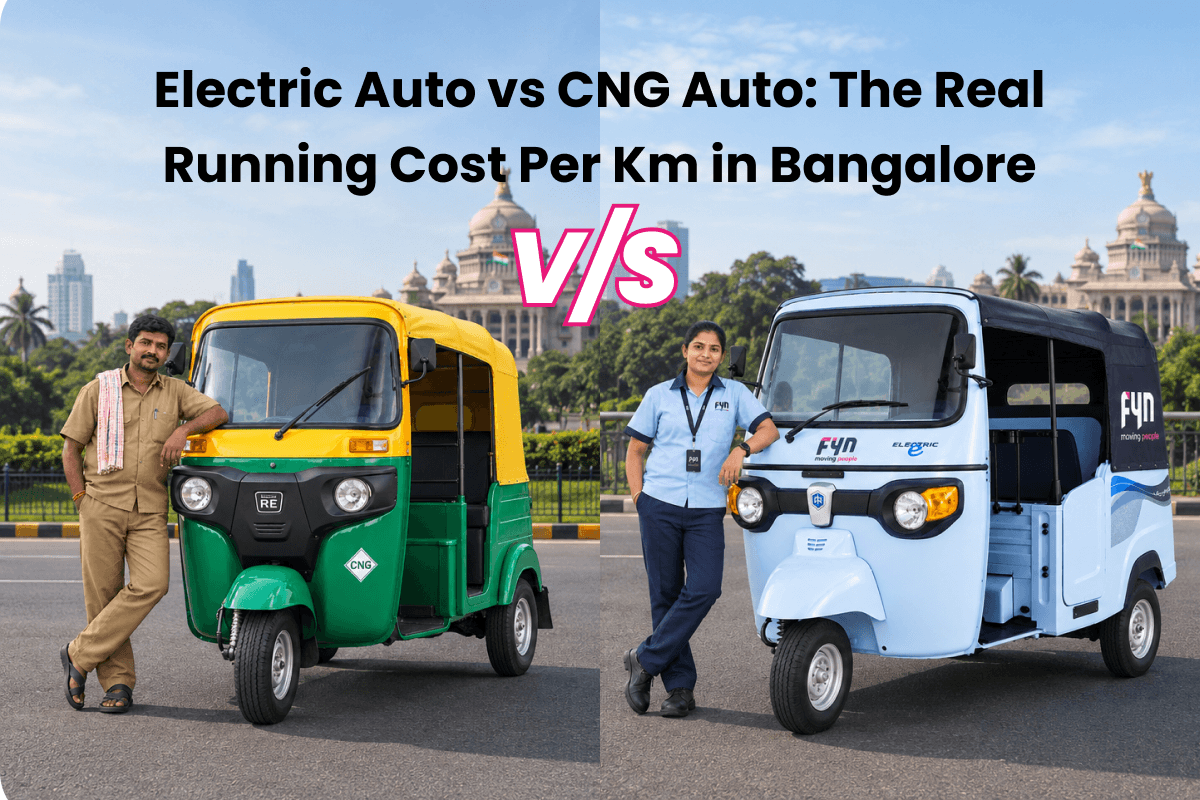
For a separate comparison of electricity and fuel expenses, read Fyn's electric auto vs CNG running-cost comparison for Bengaluru.
A policy framework is not the same as a station near you
India has introduced guidelines for the installation and operation of battery-swapping and charging stations. The Ministry of Power issued its guidelines in January 2025. Government responses have also clarified that full interoperability across all EV users is not envisaged at present.
In practical terms, policy support does not guarantee that a driver will find a working, compatible station on the route.
Four things need to line up:
- The station must exist and be operational.
- It must support the vehicle and battery configuration.
- A charged battery must be available when the driver arrives.
- The station must be conveniently located for the driver's working route.
Network figures should also be read carefully. Indofast has reported more than 1,900 stations across 24 cities, including more than 450 in Bengaluru. These are company-reported figures. A national or city-level station count does not mean every station supports every L5 vehicle or battery configuration.
Indofast's partnership with GLIDA also described an initial rollout of 10 stations across Chennai, Bengaluru and Hyderabad, with further expansion planned. A planned rollout should not be confused with a fully operational network available to every vehicle.
There is no universal battery that can be exchanged at any station. Compatibility depends on the vehicle, battery design and supported swapping network. Some networks support multiple vehicle models, but interoperability is not universal. Confirm compatibility with both the vehicle manufacturer and the swapping provider before committing to a system.
Fixed-battery charging also depends on infrastructure. A driver needs a working socket where the vehicle is parked, a reliable electricity supply and enough time to charge. Public charging stations may have queues or faults, while rapid chargers are available only for compatible vehicles and in specific locations.
Who is responsible for the battery?
The answer depends on the ownership arrangement and contract, not only on whether the battery is fixed or swappable.
In a Battery-as-a-Service or swapping arrangement, the operator often retains ownership of the battery. The driver pays according to the provider's usage or subscription arrangement. The contract should explain who maintains the battery, how its condition is monitored and who is responsible if it is damaged.
In a fixed-battery vehicle, ownership and replacement responsibilities depend on who owns the vehicle, the manufacturer's warranty and the terms of any rental or fleet agreement.
If you rent an electric auto from a fleet operator, ask what the daily rental includes, where and how the vehicle is charged, how long charging takes and what happens if the vehicle cannot be charged.
Battery safety matters in either system. Ask who is responsible if a battery is damaged and which safety standards and certifications apply to the battery and the charging or swapping equipment.
Passenger autos and cargo autos
Passenger and cargo vehicles do not necessarily have the same operating patterns. The available research also shows why driver preferences and fleet-operator preferences should not be treated as the same thing.
What drivers preferred in the 2023 survey
In the AEEE and ICA India survey, 58% of surveyed passenger e-auto drivers preferred removable batteries, while 42% preferred fixed batteries. Among surveyed cargo e-auto drivers, 74% preferred fixed batteries.
Better range was the main reason given by drivers who preferred fixed batteries. Drivers who preferred removable batteries mainly cited reduced refuelling time and the potential to use that time for additional work.
These findings describe the drivers surveyed in 2023, across Delhi, Lucknow and Bengaluru, with most respondents from Delhi. They should not be treated as a current preference shared by every passenger or cargo driver.
What fleet operators preferred in the 2020 study
A separate AEEE study, Charging India's Two- and Three-Wheeler Transport, published in September 2020, examined fleet operators and other stakeholders.
It found that the surveyed passenger e-three-wheeler fleets preferred battery swapping over plug-in charging, while logistics fleets preferred plug-in charging.
The report linked this difference to the way the vehicles were used. Passenger fleets could lose earning time while vehicles were plugged in, making swapping attractive. Logistics fleets often had larger and heavier batteries, while vehicles could be charged during periods when they were not being used.
These findings come from a different study, conducted earlier and focused on fleet-operator preferences rather than individual driver preferences. They are historical observations, not universal rules.
Fyn's Chennai passenger vs cargo auto comparison also shows that the two types of work can follow different patterns. In Fyn's dataset, passenger drivers averaged 18.10 trips a day, while cargo drivers averaged 5.48.
These figures describe Fyn's own fleet. They do not explain battery preferences or establish that one charging system is better for either category. They do show why daily distance, trip frequency, load and working schedule matter when choosing a vehicle.
Which system fits your situation?
The right choice depends on how and where you work.
- You have a working socket where the vehicle is parked overnight, and your daily distance fits within its usable range. A fixed-battery auto can be a straightforward option that avoids a mid-shift stop.
- You do not have a dependable place to charge, work long hours and have a compatible swapping station on your route. Swapping may save time, provided charged batteries are reliably available.
- Your daily distance exceeds one charge and compatible rapid chargers are available on your route. A rapid-charging vehicle may reduce the time spent refilling.
- The nearest compatible station is far from your usual working area. Be careful. The time spent travelling to a station can cancel the benefit of a quick swap.
- You rent a vehicle from a fleet. Focus on what the rental includes, where the vehicle is charged and how reliably you can complete a working day.
Before choosing a vehicle, ask for the following information in writing:
- The range for your usual load, and whether it is a certified or real-world figure.
- The exact vehicle variant and the charging or swapping networks it supports.
- The nearest compatible stations to your working area, their operating hours and battery availability.
- The current tariff for your vehicle and city, including any subscription, deposit or service charge.
- Who owns the battery, what the warranty covers and who is responsible when the battery weakens.
- What is involved in moving to another swapping network, if necessary.
- For rental vehicles, what the daily rental covers and what happens if the vehicle cannot be charged.
- Whether you can test the vehicle on your own route before committing.
How this works at Fyn
Fyn rents electric passenger autos and cargo EVs to drivers under fixed daily rental arrangements.
In the Chennai arrangement described in Fyn's passenger vs cargo comparison, the daily rental includes charging, maintenance, breakdown cover and insurance. Arrangements may differ by city and vehicle.
Fyn's services page lists passenger electric autos and fast-charge cargo EVs.
For a driver renting a vehicle, the practical questions remain the same: how far the vehicle can travel, where it can be charged, how long charging takes and what happens when the vehicle is unavailable.
To explore Fyn's electric vehicle services and driver arrangements, visit Fyn's EV services page.
Frequently asked questions
Is battery swapping better than charging for an electric auto?
Not always. Swapping can save time for a driver without a reliable place to charge, provided a compatible and well-stocked station is available on the route. A fixed-battery auto charged overnight may be simpler if the daily shift fits within its usable range. Rapid charging is a third option for compatible vehicles and locations.
How long does a battery swap take?
Indofast Energy says its battery exchange takes under two minutes. Its typical three-wheeler loader or auto configuration uses three batteries. This is the exchange time itself. Travel to the station and any waiting time add to the total interruption.
How long does it take to charge an electric auto?
Charging time depends on the vehicle and charger. Mahindra states that the Treo Xtra takes approximately five hours and 20 minutes for a full charge. Altigreen states that the neEV Tez can charge in about 15 minutes using a compatible Exponent rapid charger. These are manufacturer figures and do not apply to every electric auto.
Does battery swapping cost more than charging?
It depends on the provider, vehicle, city and charging arrangement. Swapping tariffs vary, and there is no single price that applies to all electric autos. Ask the provider for the current tariff for your exact vehicle and compare it with your actual electricity cost.
Which electric autos support battery swapping?
Examples include Piaggio's Apé E-City swappable variants. Other manufacturers and swapping providers also have vehicle-specific partnerships. Compatibility depends on the exact vehicle model, battery configuration and network. Confirm support before choosing a vehicle.
Can I swap my battery at any station?
No. There is no universal battery that works at every swapping station in India. A vehicle can use only the networks and stations that support its specific battery and configuration. Some networks support multiple vehicle models, but compatibility is not universal.
Who owns the battery in a swapping model?
In many Battery-as-a-Service arrangements, the swapping operator retains ownership of the battery and charges the user for energy or usage. The exact arrangement depends on the provider and contract. Check who is responsible for battery maintenance, damage and replacement.
Is a swappable battery better for cargo autos?
The available evidence does not establish that. In the 2023 AEEE driver survey, 74% of surveyed cargo e-auto drivers preferred fixed batteries, mainly because of range. In the separate 2020 AEEE fleet-operator study, surveyed logistics fleets also preferred plug-in charging. Both findings describe historical samples, not every cargo operator or driver.
Sources and references
The article uses manufacturer specifications, provider-published information, government material, independent research and Fyn's first-party operating data. These sources describe different vehicle models, samples and time periods, so their figures should not be treated as directly interchangeable.
Manufacturer specifications
Provider-published information and announcements
- Indofast Energy FAQ
- Autocar Professional reports on Indofast's network, the Indofast and GLIDA rollout, and the Montra and Exponent announcement dated 29 October 2026.
Research and policy
- AEEE and ICA India, Catalysing the Market Transformation of Electric Three-Wheelers in India, 2023
- AEEE, Charging India's Two- and Three-Wheeler Transport, September 2020
- CEEW, IBSA and CII, Scaling Battery Swapping for India's EV Ambitions, June 2026
Fyn first-party information